Posts

Showing posts with the label Turkey

Neolithic Site of Catalhoyuk Turkey

Image
Two hills form the 37 ha site on the Southern Anatolian Plateau. The taller eastern mound contains eighteen levels of Neolithic occupation between 7400 bc and 6200 bc, including wall paintings, reliefs, sculptures and other symbolic and artistic features. Together they testify to the evolution of social organization and cultural practices as humans adapted to a sedentary life. The western mound shows the evolution of cultural practices in the Chalcolithic period, from 6200 bc to 5200 bc. Çatalhöyük provides important evidence of the transition from settled villages to urban agglomeration, which was maintained in the same location for over 2,000 years. It features a unique street less settlement of houses clustered back to back with roof access into the buildings. Continent: Asia Country: Turkey Category: Cultural Criterion: (II)(IV) Date of Inscription: 2012

Selimiye Mosque and its Social Complex Turkey

Image
The square Mosque with its single great dome and four slender minarets, dominates the skyline of the former Ottoman capital of Edirne. Sinan, the most famous of Ottoman architects in the 16th century, considered the complex, which includes madrasas (Islamic schools), a covered market, clock house, outer courtyard and library, to be his best work. The interior decoration using Iznik tiles from the peak period of their production testifies to an art form that remains unsurpassed in this material. The complex is considered to be the most harmonious expression ever achieved of the Ottoman külliye, a group of buildings constructed around a mosque and managed as a single institution. Continent: Asia Country: Turkey Category: Cultural Criterion: (I)(IV) Date of Inscription: 2011

City of Safranbolu Turkey

Image
The site of Safranbolu has been occupied by human settlements since prehistory, as evidenced by rock-cut tombs and a Roman temple in the vicinity. The present settlement developed as a trading centre after the Turkish conquest in the 11th century. In the 13th century it became an important caravan station on the main east-west trade route. Surviving buildings from this early period include the Old Mosque, the Old Bath, and the Medresse of Siileyman Pasha. All built in 1322. Continent: Asia Country: Turkey Category: Cultural Criterion: (II)(IV) (V) Date of Inscription: 1994

Archaeological Site of Troy Turkey

Image
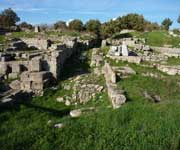
The archaeological site of Troy is of immense significance in the understanding of the development of European civilization at a critical stage in its early development. It is, moreover, of exceptional cultural importance because of the profound influence of Homer's Iliad on the creative arts over more than two millennia. Troy is a unique example in an Aegean context of the oriental city at the junction between Anatolia, the Aegean and the Balkans. It is also probably the most famous archaeological site in the world. It may be considered to represent the starting point for modern archaeology and its public recognition. Continent: Asia Country: Turkey Category: Cultural Criterion: (II)(III) (VI) Date of Inscription: 1998

Xanthos-Letoon Turkey

Image
Xanthos directly influenced Lycia throughout antiquity, as demonstrated by the many epigraphic texts found on the two sites as well as by the remarkable funerary monuments preserved there or originating from the area, and also the neighbouring provinces. The Mausoleum of Halicarnassus, one of the Seven Wonders of the Ancient World, is a direct descendant of the Nereid Monument at Xanthos. Continent: Asia Country: Turkey Category: Cultural Criterion: (I)(III) Date of Inscription: 1988

Nemrut Dag Turkey

Image
The tomb or the Hierotheseion of Nemrut Dag bears unique testimony to the civilization of the kingdom of Commagene. Antiochos I is represented in this monument as a descendant of Darius by his father Mithridates, and a descendant of Alexander by his mother Laodice. This semi-legendary ancestry translates in genealogical terms the ambition of a dynasty that sought to remain independent of the powers of both the East and the West. More than the tombs at Karakuş and Eski Kâhta, the tumulus at Nemrut Dağ illustrates, through the liberal syncretism of a very original pantheon, a significant historical period. The landscaping of the natural site of Nemrut Dağ is one of the most colossal undertakings of the Hellenistic epoch (some of the stone blocks used weigh up to 9 tonnes). Continent: Asia Country: Turkey Category: Cultural Criterion: (I) (III)(IV) Date of Inscription: 1987

Hattusha The Hittite Capital Turkey

Image
The archaeological site of Hattusha, former capital of the Hittite Empire, is notable for its urban organization, the types of construction that have been preserved (temples, royal residences, fortifications), the rich ornamentation of the Lions' Gate and the Royal Gate, and the ensemble of rock art at Yazilikaya. The city enjoyed considerable influence in Anatolia and northern Syria in the 2nd millennium B.C. Hattusha exerted dominating influence upon the civilizations of the 2nd and 1st millennia BC in Anatolia and northern Syria. The palaces, temples, trading quarters and necropolis of this political and religious metropolis provide a comprehensive picture of a capital and bear a unique testimony to the disappeared Hittite civilization. The city's fortifications, along with the Lion Gate and the Royal Gate and the Yazılıkaya rupestral ensemble with its sculptured friezes, represent unique artistic achievements as monuments Continent: Asia Country: Turkey Category...

Historic Areas of Istanbul Turkey

Image
Istanbul bears unique testimony to the Byzantine and Ottoman civilizations. Throughout history, the monuments in the centre of the city have exerted considerable influence on the development of architecture, monumental arts and the organization of space, in both Europe and Asia. Thus, the 6,650 m terrestrial wall of Theodosius II with its second line of defences, created in AD 447, was one of the leading references for military architecture even before St Sophia became a model for an entire family of churches and later mosques and before the mosaics of the palaces and churches of Constantinople influenced Eastern and Western Christian art. Continent: Asia Country: Turkey Category: Cultural Criterion: (I) (II) (III) (IV) Date of Inscription: 1985

Great Mosque and Hospital of Divrigi Turkey

Image
The Divrigi mosque is an outstanding example of Selçuk mosques in Anatolia, having neither a courtyard, colonnades, nor an uncovered ablutions basin, but which (owing perhaps to the harshness of the climate) organizes all religious functions in an enclosed area. A charitable foundation, the contiguous hospital makes an already exceptional ensemble even more interesting thanks to a princely command. Far away from the major communication links at the south-east of Sivas province in eastern Anatolia, the mountainous region of Divrigi (Tephrike in the Byzantine Empire) was a 12th-century refuge for the Paulician Christian sect who was persecuted by Basil I and then by John Tzimisces, who exiled their survivors to Thrace. From there the heresy gradually moved westward, gaining followers of varying degrees of loyalty such as the Bogarmils or Cathars. Continent: Asia Country: Turkey Category: Cultural Criterion: (I)(IV) Date of Inscription: 1985

Goreme National Park and the Rock Sites of Cappadocia Turkey

Image
In a spectacular landscape, entirely sculpted by erosion, the Goreme valley and its surroundings contain rock-hewn sanctuaries that provide unique evidence of Byzantine art in the post-Iconoclastic period. Dwellings, troglodyte villages and underground towns – the remains of a traditional human habitat dating back to the 4th century – can also be seen there. The rupestral sanctuaries of Cappadocia constitute a unique artistic achievement in a region of superlative natural features, providing irreplaceable testimony to post-iconoclast Byzantium. The dwellings, village convents and churches retain the fossilized images of a province of the Byzantine Empire between the 4th century and the Turkish invasion. Continent: Asia Country: Turkey Category: Mixed Criterion: (I)(III) (V) (VII) Date of Inscription: 1985

Selimiye Mosque and its Social Complex Turkey

Image
The square Mosque with its single great dome and four slender minarets, dominates the skyline of the former Ottoman capital of Edirne. Sinan, the most famous of Ottoman architects in the 16th century, considered the complex, which includes madrasas (Islamic schools), a covered market, clock house, outer courtyard and library, to be his best work. The interior decoration using Iznik tiles from the peak period of their production testifies to an art form that remains unsurpassed in this material. The complex is considered to be the most harmonious expression ever achieved of the Ottoman külliye, a group of buildings constructed around a mosque and managed as a single institution besides Selimiye Mosque and its Social Complex declared UNESCO heritage site in 2011. Continent: Asia Country: Turkey Category: Cultural Criterion: (I)(IV) Date of Inscription: 2011

Hierapolis-Pamukkale Turkey

Image
Deriving from springs in a cliff almost 200 m high overlooking the plain, calcite-laden waters have created at Pamukkale (Cotton Palace) an unreal landscape, made up of mineral forests, petrified waterfalls and a series of terraced basins. At the end of the 2nd century B.C. the dynasty of the Attalids, the kings of Pergamon, established the thermal spa of Hierapolis. The ruins of the baths, temples and other Greek monuments can be seen at the site. This site is exceptional by vurtue of its superlative natural phenomena - warm, heavily mineralized water flowing from springs creating pools and terraces which are visually stunning. It is on this outstanding natural site that Hierapolis, an exceptional example of a Graeco-Roman thermal installation, was established. The Christian monuments of Hierapolis constitute an outstanding example of an early Christian architectural complex. Pamukkale, which literally means 'cotton castle', is the name the Turks gave to the extraordinary si...