Posts

Showing posts with the label European Heritage Sites

A Heritage Look of World’s Smallest Country Vatican City

Image
The Vatican City, one of the most sacred places in Christendom, attests to a great history and a formidable spiritual venture. A unique collection of artistic and architectural masterpieces lie within the boundaries of this small state. At its centre is St Peter's Basilica, with its double colonnade and a circular piazza in front and bordered by palaces and gardens. The basilica, erected over the tomb of St Peter the Apostle, is the largest religious building in the world, the fruit of the combined genius of Bramante, Raphael, Michelangelo, Bernini and Maderna. Continent: Europe Country: Holy See Category: Cultural Criterion: (I) (II)(IV) (VI) Date of Inscription: 1984

Old Village of Holloko and its Surroundings Hungary

Image
Hollokö is an exceptional example of a deliberately preserved traditional human settlement representative of a culture that has become vulnerable under the impact of irreversible change. This village, which developed mainly during the 17th and 18th centuries, is a living example of rural life before the agricultural revolution of the 20th century. Located about 100 km north-east of Budapest, Hollokö is a small rural community whose 126 houses and farm buildings, strip-field farming, orchards, vineyards, meadows and woods cover 141 ha. The village and the surrounding area are given the same protection as a historic monument such as the castle. Mentioned as early as 1310, this castle, whose ruins lie to the north-west of the village today, played a decisive part in the feudal wars of the Palocz and the Hussite wars. It served as protection for the village whose ruins have been found a little way from its walls. Continent: Europe Country: Hungary Category: Cultural Criterion...

Early Christian Necropolis of Pecs Hungary

Image
The part of modern Hungary west of the Danube, which was first settled in the Neolithic period, came into the Roman Empire in the 1st century CE. It formed part of the Roman province of Pannonia. The town of Sopianae was founded on the southern slope of the Mecsek massif in the 2nd century by colonists coming from western Pannonia and Italy, who intermarried with the indigenous Illyrian-Celtic peoples. It became the headquarters of the civil governor (praeses) of the new province of Valeria at the end of the 3rd century. Sopianae was especially prosperous in the 4th century because of its situation at the junction of several important trading and military routes. Archaeological excavations have revealed a number of new public buildings in the forum area from this time. Continent: Europe Country: Hungary Category: Cultural Criterion: (III)(IV) Date of Inscription: 2000

Monastic Island of Reichenau Germany

Image
The remains of the Reichenau foundation bear outstanding witness to the religious and cultural role of a great Benedictine monastery in the early middle Ages. The Monastery of Reichenau was a highly significant artistic centre of great significance to the history of art in Europe in the 10th and 11th centuries, as is superbly illustrated by its monumental wall paintings and its illuminations. The churches retain remarkable elements of several stages of construction and thus offer outstanding examples of monastic architecture in Central Europe from the 9th to the 11th centuries. Continent: Europe Country: Germany Category: Cultural Criterion: (III)(IV) (VI) Date of Inscription: 2000

World Heritage Budapest Hungary

Image
At the end of the 17th century a wall surrounded the city of Pest and for the most part Germans lived along the banks of the Danube. The areas outside of the city were arable land with fruit orchards, but by 1699 craftsmen had begun to establish suburban communities. From 1730 they began to settle an area then called Pacsirtamezq. In 1777 it was renamed Terezvaros after Saint Theresa and in honour of Maria Theresa. The parish church of Terezvaros was built in 1801-09 and by 1805 the current street grid had taken shape. Most of the merchants in the area settled and established themselves along Kiraly Street. At the beginning of the 20th century the areas of Erzsebetvaros and the City Park split off from this district. Continent: Europe Country: Hungary Category: Cultural Criterion: (II)(IV) Date of Inscription: 2002

Zollverein Coal Mine Industrial Complex in Essen Germany

Image
Consolidation of the mining claim area was completed in December 1847: the area concerned covered 13.2km2. At that time it was the northernmost mine in the region. It belongs to the Gelsenkirchen anticline, in which the coal seams, averaging 1.17m thick, are deeply stratified. Mining began in the mid-19th century at a depth of c 120m and finished at the fourteenth level (1200m). By the end of mining the underground roadways extended over 120km; they were accessed by twelve shafts, opened up progressively between 1847 and 1932. When Zollverein XII was opened, the earlier shafts were used solely for the movement of men and supplies; all the extracted coal was handled by the new shaft until the mine closed in 1986. The methods of mining evolved as technology developed from hand picks to mechanized coal cutting.t Continent: Europe Country: Germany Category: Cultural Criterion: (II)(III) Date of Inscription: 2001

Tokaj Wine Region Historic Cultural Landscape Hungary

Image
The entire landscape of the Tokaji wine region, including both vineyards and long established settlements, vividly illustrates a specialized form of traditional land use and represents a distinct viticultural tradition that has existed for at least 1,000 years and which has survived intact to the present day. The Magyar tribes who entered the area at the end of the 9th century assigned special significance to the region, as they believed (with some justification) that it was the centre of the empire of Attila the Hun, with whom they closely identified themselves. It became a protected refuge for Hungarians in the centuries that followed in the face of pressure from invading Mongols and others, as well as an important commercial crossroads for Polish merchants travelling to the Balkans and elsewhere. Continent: Europe Country: Hungary Category: Cultural Criterion: (III)(V) Date of Inscription: 2002

Classical Weimar Germany

Image
The high artistic quality of the public and private buildings and parks in and around the town testify to the remarkable cultural flowering of the Weimar classical period. Enlightened ducal patronage attracted many of the leading writers and thinkers in Germany, such as Goethe, Schiller and Herder, to Weimar in the late 18th and early 19th centuries, making it the cultural centre of the Europe of the day. Weimar became the capital of the Duchy of Sachsen-Weimar-Eisenach in 1572. For many years the painter Lucas Cranach the Elder worked in Weimar, where he died in 1553. This marked the start of a long period of growing cultural importance in which many painters, writers, poets, and philosopher lived in the city - Johann Sebastian Bach, Christoph Martin Wieland, Johann Wolfgang Goethe, Johann Gottfried Herder, Friedrich Schiller, Franz Liszt, Henry van de Velde, and Walter Gropius. Continent: Europe Country: Germany Category: Cultural Criterion: (III)(VI) Date of Inscript...

Thracian Tomb of Sveshtari Bulgaria

Image
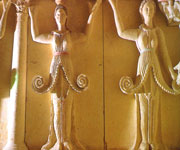
The discovery in 1982 of the Thracian tomb of Sveshtari was one of the most spectacular archaeological events of the 20th century. The tomb itself is a unique artistic achievement with its half-human, half-vegetable caryatids enclosed in chitons in the shape of inverted palmettes. The fact the original polychromy has been preserved with its ochre, brown, blue, red and lilac shades adds to the bewitching charm of an expressive composition where the anthropomorphic supports conjure up the image of a choir of mourners frozen in the abstract positions of a ritual dance. The tomb is an exceptional testimony to the culture of the Getae, a Thracian people living in the north of Hemus, in contact with the Greek and Hyperborean worlds according to ancient geographers. Continent: Europe Country: Bulgaria Category: Cultural Criterion: (I)(III) Date of Inscription: 1985

Wartburg Castle Germany

Image
The Castle of Wartburg is an outstanding monument of the feudal period in central Europe. It is rich in cultural associations, most notably its role as the place of exile of Martin Luther, who composed his German translation of the New Testament there. It is also a powerful symbol of German integration and unity. The legendary creation of the castle is attributed to Count Ludwig der Springer. The first steps in its construction were taken in 1067, and it became one of the key points in the early years of Ludovician sovereignty. Continent: Europe Country: Germany Category: Cultural Criterion: (III)(VI) Date of Inscription: 1999

Rock-Hewn Churches of Ivanovo Bulgaria

Image
In the valley of the Roussenski Lom River, in north-east Bulgaria, a complex of rock-hewn churches, chapels, monasteries and cells developed in the vicinity of the village of Ivanovo. This is where the first hermits had dug out their cells and churches during the 12th century. The 14th-century murals testify to the exceptional skill of the artists of the Tarnovo School of painting. he period of the history of Bulgaria from the last years of the 12th century, when for the second time the country became independent from Byzantium, until the Ottoman Empire annexation in 1396, is known as the Second Bulgarian Empire. Continent: Europe Country: Bulgaria Category: Cultural Criterion: (II)(III) Date of Inscription: 1979

Museumsinsel Museum Island Berlin Germany

Image
The art museum is a social phenomenon that owes its origins to the Age of Enlightenment and its extension to all people to the French Revolution. The Museumsinsel is the most outstanding example of this concept given material form and a symbolic central urban setting, and one that illustrates the evolution of modern museum design over more than a century. The present importance of the Museumsinsel began when the Altes Museum was built to the designs of Karl Friedrich Schinkel in 1824-28. A plan to develop the part of the island behind this museum was drawn up in 1841 by the court architect, Friedrich August Stuler, on the orders of Friedrich Wilhelm IV. The first element of this plan to be built was the Neues Museum (1843-47). The next step did not take place until 1866, when the Nationalgalerie, the work of Johann Heinrich Strack, was built. Another two decades passed before the Kaiser-Friedrich-Museum (now the Bodemuseum) was built in 1897-1904 to the designs of Ernst von Ihne, and...

Ferto-Neusiedler Cultural Landscape Hungary

Image
The Ferto-Neusiedler Lake and its surroundings are an outstanding example of a traditional human settlement and land use representative of a culture. The present character of the landscape is the result of millennia-old land-use forms based on stockraising and viticulture to an extent not found in other European lake areas. The historic centre of the medieval free town of Rust constitutes an outstanding example of a traditional human settlement representative of the area. The town exhibits the special building mode of a society and culture within which the lifestyles of townspeople and farmers form a united whole. The Ferto-Neusiedler Lake has been the meeting place of different cultures for eight millennia, and this is graphically demonstrated by its varied landscape, the result of an evolutionary and symbiotic process of human interaction with the physical environment. Continent: Europe Country: Hungary Category: Cultural Criterion: (V) Date of Inscription: 2001

Garden Kingdom of Dessau Worlitz Germany

Image
The Garden Kingdom of Dessau-Wörlitz is an outstanding example of the application of the philosophical principles of the Age of the Enlightenment to the design of a landscape that integrates art, education and economy in a harmonious whole. The first essays in landscape design began with the foundation of Oranienbaum, with its unified layout of town, palace, and park from 1683 onwards. The resulting complete Baroque ensemble, with obvious Dutch connections deriving from its designer, Cornelis Ryckwaert, has survived to the present day. Continent: Europe Country: Germany Category: Cultural Criterion: (II)(IV) Date of Inscription: 2000

Hortobagy National Park the Puszta Hungary

Image
The landscape of the Hungarian Pasta, an outstanding example of a cultural landscape shaped by a pastoral human society, preserves intact and visible the evidence of its traditional use over more than two millennia and represents the harmonious interaction between human beings and nature. The Puszta consists of a vast area of plains and wetlands in eastern Hungary. Traditional forms of land use, such as the grazing of domestic animals, have been present in this pastoral society for more than two millennia. Continent: Europe Country: Hungary Category: Cultural Criterion: (IV)(V) Date of Inscription: 1999

Historic Centres of Stralsund and Wismar Germany

Image
The historic towns of Wismar and Stralsund are situated in north-eastern Germany on the Baltic Sea coast. The cities were founded as part of the German colonization of the Slav territories in the late 12th or early 13th centuries. Both cities emerged as important trading places in the 14th century as part of the Hanseatic League. After the Thirty Years' War the towns came under Swedish rule from the 17th to the early 19th centuries. Under the subsequent changing political situations there was a period of stagnation, but from the second half of the 19th century a gradual economic improvement began. The historic centres survived the World War II bombardments and were part of the German Democratic Republic until German unification. Continent: Europe Country: Germany Category: Cultural Criterion: (II)(IV) Date of Inscription: 2002

Thracian Tomb of Kazanlak Bulgaria

Image
In 1942 a tomb dated to the 3rd century BC was discovered near Kazanlak in the romantic Valley of Roses, near the ancient city of Teutopolis. The Kazanlak Tomb is a peak in the development of Hellenistic art; it is a significant contribution to the art of the entire Hellenistic world. The numerous burial mounds in the Kazanlak area (more than 500), together with the remains of Thracian settlements, including Seuthopolis, the only Thracian city that has been completely excavated, preserved and researched, show that the area was inhabited by a large Thracian population, which reached the height of its cultural development during the 5th to 3rd centuries BC. Continent: Europe Country: Bulgaria Category: Cultural Criterion: (I) (III) (IV) Date of Inscription: 1979

Madara Rider Bulgaria

Image
The sculptor carved a relief of a majestic horseman 23 m above ground level in an almost vertical 100 m high cliff. The horseman is thrusting a spear into a lion lying at his horse's feet, while a dog runs after the horseman. In antiquity the Thracian tribes inhabited the plain. There was an ancient Thracian sanctuary in the large open cave under the rocks, which is known today as the Nymphs' Cave.The fortress and a large farm (villa rustica) prospered at the foot of the cliff for more than three centuries during Roman times, until it fell into disuse with the decline of the Roman Empire. The pitched towers of the fortress were rebuilt when the first Bulgarian capital, Pliska, was established nearby. Continent: Europe Country: Bulgaria Category: Cultural Criterion: (I)(III) Date of Inscription: 1979

Ancient City of Nessebar Bulgaria

Image
Systematic archaeological studies, reinforcement, restoration and conservation have preserved the material traces of history in Nessebar more than anywhere else. The small peninsula is a meeting place of bygone times. Nessebar has demonstrated on several occasions the significant historic position of a frontier city on the outposts of a threatened empire. The millennia of uninterrupted human occupation (the earliest traces of human settlement date back to over 3,000 years ago) have produced an impressive cultural occupation layer that is as thick as 6 m in some places. Continent: Europe Country: Bulgaria Category: Cultural Criterion: (III)(IV) Date of Inscription: 1983

Pirin National Park Bulgaria

Image
Pirin National Park is extending over an area of 27,400 ha and lying at an altitude of 1,008-2,914 m in the Pirin Mountains, south-west Bulgaria, Pirin National Park has a limestone Balkan landscape, with lakes, waterfalls, caves and pine forests. The rugged mountains, with some 70 glacial lakes scattered throughout them, are home to hundreds of endemic and rare species, many of which are representative of the Balkan Pleistocene flora. The mountains also have diverse and unique landscapes of great aesthetic value. Continent: Europe Country: Bulgaria Category: Natural Criterion: (VII)(VIII) (IX) Date of Inscription: 1983