Posts

Showing posts with the label Heritage Monuments

The Historic Centre of Macao in China

Image
The Historic Centre of Macao was settled by fishing people long before the arrival of foreigners. It was a sheltered bay on the peninsula and a stopping point for seafarers sailing down the Chinese coast from Fujian province. The temple for the Goddess A-Ma, built in the late 15th century, is testimony to their faith. The Portuguese first arrived to China in 1513, visiting the famous market of Canton. In 1557, they arrived in Macao, which became the oldest permanent European settlement in East Asia. Continent: Asia Country: China Category: Cultural Criterion: (II)(III) (IV) (VI) Date of Inscription: 2005

Sun Temple Konarak Orissa

Image
Sun Temple, Konarak is located on the shores of the Bay of Bengal, bathed in the rays of the rising sun, the temple at Konarak is a monumental representation of the sun god Surya's chariot; its 24 wheels are decorated with symbolic designs and it is led by a team of six horses. Built in the 13th century, it is one of India's most famous Brahman sanctuaries. Konarak is an outstanding testimony to the 13th-century kingdom of Orissa. It is directly and materially linked to Brahmin beliefs, and forms the invaluable link in the history of the diffusion of the cult of Surya, which originated in Kashmir during the 8th century and finally reached the shores of eastern India. Continent: Asia Country: India Category: Cultural Criterion: (I)(III) (VI) Date of Inscription: 1984 Brahmin temple of Kimarak On the eastern coast of India, south of the Mahanadi Delta, is the Brahmin temple of Kimarak (still spelled as Konarak or Konarka), one of the most famous Brahmin ...

Sandstone Tower of Qutb Minar and its Monuments

Image
Qutb Minar was built in the early 13th century a few kilometres south of Delhi; the red sandstone tower of Qutb Minar is 72.5 m high, tapering from 2.75 m in diameter at its peak to 14.32 m at its base, and alternating angular and rounded flutings. The surrounding archaeological area contains funerary buildings, notably the magnificent Alai-Darwaza Gate, the masterpiece of Indo-Muslim art (built in 1311), and two mosques, including the Quwwatu'l-Islam, the oldest in northern India, built of materials reused from some 20 Brahman temples. Continent: Asia Country: India Category: Cultural Criterion: (IV) Date of Inscription: 1993 The Qutb Complex Lalkot is the first of the seven cities of Delhi, established by the Tomar Rajput ruler, Anang Pal, in 1060. The Qutb complex lies in the middle of the eastern part of Lalkot. Building of the Quwwatu'l-Islam (Might of Islam) congregational mosque was begun in 1192 by Qutbu'd-Din Aibak and completed in 1198, u...

Humayun's Tomb India

Image
Humayun's Tomb, built in 1570, is of particular cultural significance as it was the first garden-tomb on the Indian subcontinent. It inspired several major architectural innovations, culminating in the construction of the Taj Mahal. Exemplifying the formative stage of the Mughal structural style, Humayun's Tomb stands as a landmark in the development of Mughal architecture, and also represents the earliest extant specimen of the Mughal scheme of the garden tomb, with causeways and channels. It is a well-developed specimen of the double-domed elevation with kiosks on a grand scale. This building tradition culminated in the Taj Mahal, constructed a century later. Despite being the first standardized example of this style, Humayun's Tomb is an architectural achievement of the highest order. Continent: Asia Country: India Category: Cultural Criterion: (II)(IV) Date of Inscription: 2011 The Tomb of Humayun The tomb of Humayun, second Mughal Emperor of India...

The City of Victory

Image
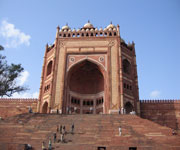
Built during the second half of the 16th century by the Emperor Akbar, Fatehpur Sikri or the City of Victory was the capital of the Mughal Empire for only some 10 years. The complex of monuments and temples, all in a uniform architectural style, includes one of the largest mosques in India, the Jama Masjid. Fatehpur Sikri bears exceptional testimony to the Mughal civilization at the end of the 16th century. It offers a unique example of architectural ensembles of very high quality constructed between 1571 and 1585. Its form and layout strongly influenced the evolution of Indian town planning, notably at Shahjahanabad (Old Delhi). Continent: Asia Country: India Category: Cultural Criterion: (II)(III) (IV) Date of Inscription: 1986 Fatehpur Sikri The 'City of Victory' had only an ephemeral existence as the capital of the Mughal Empire. The Emperor Akbar (1556-1605) decided to construct it in 1571, on the same site where the birth of his son, the future J...

Ellora Caves Monasteries and Temples

Image
The 34 Ellora Caves Monasteries and Temples, extending over more than 2 km, were dug side by side in the wall of a high basalt cliff, not far from Aurangabad, in Maharashtra. Ellora, with its uninterrupted sequence of monuments dating from A.D. 600 to 1000, brings the civilization of ancient India to life. Not only is the Ellora complex a unique artistic creation and a technological exploit but, with its sanctuaries devoted to Buddhism, Hinduism and Jainism, it illustrates the spirit of tolerance that was characteristic of ancient India. Continent: Asia Country: India Category: Cultural Criterion: (I)(III) (VI) Date of Inscription: 1983

City of Caves

Image
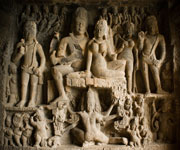
The 'City of Caves', on an island in the Sea of Oman close to Bombay, contains a collection of rock art linked to the cult of Shiva. Here, Indian art has found one of its most perfect expressions, particularly the huge high reliefs in the main cave. The island of Elephanta, the glorious abode of Lord Shiva and an epitome of Hindu cave culture, consists of seven caves on an island in the Sea of Oman close to Mumbai which, with their decorated temples and the images from Hindu mythology, bear a unique testimony to a civilization that has disappeared. Here, Indian art has found one of its most perfect expressions, particularly in the huge high reliefs in the main cave. Continent: Asia Country: India Category: Cultural Criterion: (I)(III) Date of Inscription: 1987

Group of Buddhist Monuments Sanchi

Image
On a hill overlooking the plain and about 40 km from Bhopal, the site of Sanchi comprises a group of Buddhist monuments (monolithic pillars, palaces, temples and monasteries) all in different states of conservation most of which date back to the 2nd and 1st centuries B.C. It is the oldest Buddhist sanctuary in existence and was a major Buddhist centre in India until the 12th century A.D. From the time that the oldest preserved monument on the site (Asoka's column with its projecting capital of lions inspired by Achaemenid art) was erected, Sanchi's role as intermediary for the spread of cultures and their peripheral arts throughout the Maurya Empire, and later in India of the Sunga, Shatavahana, Kushan and Gupta dynasties, was confirmed. Continent: Asia Country: India Category: Cultural Criterion: (I)(II) (III)(IV) (VI) Date of Inscription: 1989

Palace fort of Shahjahanabad

Image
The Red Fort Complex was built as the palace fort of Shahjahanabad – the new capital of the fifth Mughal Emperor of India, Shah Jahan. Named for its massive enclosing walls of red sandstone, it is adjacent to an older fort, the Salimgarh, built by Islam Shah Suri in 1546, with which it forms the Red Fort Complex. The private apartments consist of a row of pavilions connected by a continuous water channel, known as the Nahr-i-Behisht (Stream of Paradise). The Red Fort is considered to represent the zenith of Mughal creativity which, under the Shah Jahan, was brought to a new level of refinement. Continent: Asia Country: India Category: Cultural Criterion: (II)(III) (VI) Date of Inscription: 2007

Astronomical observation Jantar Mantar

Image
The Jantar Mantar, in Jaipur, is an astronomical observation site built in the early 18th century. It includes a set of some 20 main fixed instruments. They are monumental examples in masonry of known instruments but which in many cases have specific characteristics of their own. Designed for the observation of astronomical positions with the naked eye, they embody several architectural and instrumental innovations. This is the most significant, most comprehensive, and the best preserved of India's historic observatories. It is an expression of the astronomical skills and cosmological concepts of the court of a scholarly prince at the end of the Mughal period. Continent: Asia Country: India Category: Cultural Criterion: (III)(IV) Date of Inscription: 2010

Ancient Hindu architecture Champaner-Pavagadh Archaeological Park

Image
The Champaner-Pavagadh Archaeological Park with its ancient Hindu architecture, temples and special water-retaining installations, together with its religious, military and agricultural structures, dating back to the regional capital city built by Mehmud Begda in the 16th century, represents a perfect blend of Hindu and Muslim architecture, mainly in the Great Mosque (Jami Masjid), which was a model for later mosque architecture in India. This special style comes from the significant period of regional sultanates. It is furthermore an outstanding example of a very short-lived capital, making the best use of its setting, topography and natural. Continent: Asia Country: India Category: Cultural Criterion: (III)(IV) (V) (VI) Date of Inscription: 2011

Temple and Cemetery of Confucius China

Image
Confucius (551-479 BC) was a renowned philosopher, politician, and educator in the spring and Autumn Period. The system of belief that he created was adopted as the pre-eminent ideology in feudal Chinese society for more than two thousand years: he was the "Sacred First Teacher" and Sacred Model Teacher for Ten Thousand Years". Two years after his death Duke Gun of Lu consecrated his former house in Qufu as a temple, within which were preserved his clothing, musical instruments, carriage, and books. Continent: Asia Country: China Category: Cultural Criterion: (I)(IV) (VI) Date of Inscription: 1994

Historic Centre of Shakhrisyabz Uzbekistan

Image
The Historic Centre of Shakhrisyabz, located on the Silk Roads in southern Uzbekistan, is over 2000 years old and was the cultural and political centre of the Kesh region in the 14th and 15th century. A collection of exceptional monuments and ancient quarters can be found within the medieval walls, parts of which still remain. The Historic Centre of Shakhrisabz bears witness to the city's secular development and to centuries of its history, and particularly to the period of its apogee, under the empire of Temur, in the 15th century. Construction of elements continued in Shakhrisyabz throughout different time periods, lending a unique character to the place by the succession of different architectural styles. Despite the inroads of time, the remaining vestiges are still impressive in the harmony and strength of styles, an enriching addition to the architectural heritage of Central Asia and the Islamic world. Continent: Asia Country: Uzbekistan Category: Cultural Criter...

Historic Centre of Bukhara Uzbekistan

Image
Bukhara, which is situated on the Silk Route, is some 25 centuries old. It is the most complete example of a medieval city in Central Asia, with an urban fabric that has remained largely intact. Monuments of particular interest include the famous tomb of Ismail Samani, a masterpiece of 10th-century Muslim architecture, and a large number of 17th-century madrasas. The historic part of the city, which is in effect an open-air museum, combines the city's long history in a single ensemble. Continent: Asia Country: Uzbekistan Category: Cultural Criterion: (II)(IV) (VI) Date of Inscription: 1993

Complex of Hue Monuments Vietnam

Image
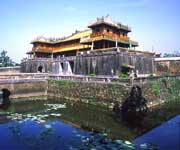
Complex of Hue Monuments represents an outstanding demonstration of the power of the vanished Vietnamese feudal empire at its apogee in the early 19th century. The complex of monuments is an outstanding example of an eastern feudal capital and of the planning and construction of a complete defended capital city in a relatively short period. The integrity of town layout and building design make it an exceptional specimen of late feudal urban planning. Hue served as the administrative centre of southern Vietnam in the 17th and 18th centuries. Gia Long, first ruler of the Nguyen dynasty, made it the national capital of united Vietnam in 1802, a position that it held until 1945. Continent: Asia Country: Vietnam Category: Cultural Criterion: (IV) Date of Inscription: 1993

World Heritage Ellora Caves India

Image
The Ellora Caves not only bear witness to three great religions Buddhism, Brahminism and Jainism but they also illustrate the spirit of tolerance, characteristic of ancient India, which permitted these three religions to establish their sanctuaries and their communities in a single place, which thus served to reinforce its universal value. The caves, with their uninterrupted sequence of from 600 to 1,000 monuments, bring to life again the civilization of ancient India. Continent: Asia Country: India Category: Cultural Criterion: (I)(III) (VI) Date of Inscription: 1983

Paphos Cyprus

Image
Paphos has been inhabited since the Neolithic period. It was a centre of the cult of Aphrodite and of pre-Hellenic fertility deities. Aphrodite's legendary birthplace was on this island, where her temple was erected by the Myceneans in the 12th century B.C. The remains of villas, palaces, theatres, fortresses and tombs mean that the site is of exceptional architectural and historic value. The mosaics of Nea Paphos are among the most beautiful in the world. Because of their great antiquity, and because they are closely and directly related to the cult and legend of Aphrodite (Venus), who became the ideal of beauty and love, inspiring writers, poets and artists throughout human history, Paphos is of outstanding universal value. Continent: Europe Country: Cyprus Category: Cultural Criterion: (III)(VI) Date of Inscription: 1980

Mir Castle Complex Belarus

Image
Mir Castle Complex construction of the castle by the Ilyinichi family began at the end of the 15th century, in Gothic style; it was subsequently extended and reconstructed. The initial work consisted of building the walls and towers in Gothic style, but work came to an end for some unknown reason. Building had been completed by the beginning of the 17th century with the addition of palatial accommodation, with some Renaissance features, after it had passed to the Radzivill family. Following sieges in 1655 and 1706 reconstruction work involved the addition of some Baroque features. Continent: Europe Country: Belarus Category: Cultural Criterion: (II)(IV) Date of Inscription: 2000

Medieval Monuments in Kosovo Serbia

Image
The four edifices of the site reflect the high points of the Byzantine-Romanesque ecclesiastical culture, with its distinct style of wall painting, which developed in the Balkans between the 13th and 17th centuries. The Decani Monastery was built in the mid-14th century for the Serbian king Stefan Decanski and is also his mausoleum. The Patriarchate of Peć Monastery is a group of four domed churches featuring series of wall paintings. The 13th-century frescoes of the Church of Holy Apostles are painted in a unique, monumental style. Early 14th-century frescoes in the church of the Holy Virgin of Ljevisa represent the appearance of the new so-called Palaiologian Renaissance style, combining the influences of the eastern Orthodox Byzantine and the Western Romanesque traditions. The style played a decisive role in subsequent Balkan art. Continent: Europe Country: Serbia Category: Danger Criterion: (II) (III) (IV) Date of Inscription: 2004

Hierapolis-Pamukkale Turkey

Image
Deriving from springs in a cliff almost 200 m high overlooking the plain, calcite-laden waters have created at Pamukkale (Cotton Palace) an unreal landscape, made up of mineral forests, petrified waterfalls and a series of terraced basins. At the end of the 2nd century B.C. the dynasty of the Attalids, the kings of Pergamon, established the thermal spa of Hierapolis. The ruins of the baths, temples and other Greek monuments can be seen at the site. This site is exceptional by vurtue of its superlative natural phenomena - warm, heavily mineralized water flowing from springs creating pools and terraces which are visually stunning. It is on this outstanding natural site that Hierapolis, an exceptional example of a Graeco-Roman thermal installation, was established. The Christian monuments of Hierapolis constitute an outstanding example of an early Christian architectural complex. Pamukkale, which literally means 'cotton castle', is the name the Turks gave to the extraordinary si...