Posts

Showing posts with the label Bulgaria

Thracian Tomb of Sveshtari Bulgaria
Image
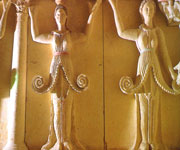
The discovery in 1982 of the Thracian tomb of Sveshtari was one of the most spectacular archaeological events of the 20th century. The tomb itself is a unique artistic achievement with its half-human, half-vegetable caryatids enclosed in chitons in the shape of inverted palmettes. The fact the original polychromy has been preserved with its ochre, brown, blue, red and lilac shades adds to the bewitching charm of an expressive composition where the anthropomorphic supports conjure up the image of a choir of mourners frozen in the abstract positions of a ritual dance. The tomb is an exceptional testimony to the culture of the Getae, a Thracian people living in the north of Hemus, in contact with the Greek and Hyperborean worlds according to ancient geographers. Continent: Europe Country: Bulgaria Category: Cultural Criterion: (I)(III) Date of Inscription: 1985

Rock-Hewn Churches of Ivanovo Bulgaria

Image
In the valley of the Roussenski Lom River, in north-east Bulgaria, a complex of rock-hewn churches, chapels, monasteries and cells developed in the vicinity of the village of Ivanovo. This is where the first hermits had dug out their cells and churches during the 12th century. The 14th-century murals testify to the exceptional skill of the artists of the Tarnovo School of painting. he period of the history of Bulgaria from the last years of the 12th century, when for the second time the country became independent from Byzantium, until the Ottoman Empire annexation in 1396, is known as the Second Bulgarian Empire. Continent: Europe Country: Bulgaria Category: Cultural Criterion: (II)(III) Date of Inscription: 1979

Thracian Tomb of Kazanlak Bulgaria

Image
In 1942 a tomb dated to the 3rd century BC was discovered near Kazanlak in the romantic Valley of Roses, near the ancient city of Teutopolis. The Kazanlak Tomb is a peak in the development of Hellenistic art; it is a significant contribution to the art of the entire Hellenistic world. The numerous burial mounds in the Kazanlak area (more than 500), together with the remains of Thracian settlements, including Seuthopolis, the only Thracian city that has been completely excavated, preserved and researched, show that the area was inhabited by a large Thracian population, which reached the height of its cultural development during the 5th to 3rd centuries BC. Continent: Europe Country: Bulgaria Category: Cultural Criterion: (I) (III) (IV) Date of Inscription: 1979

Madara Rider Bulgaria

Image
The sculptor carved a relief of a majestic horseman 23 m above ground level in an almost vertical 100 m high cliff. The horseman is thrusting a spear into a lion lying at his horse's feet, while a dog runs after the horseman. In antiquity the Thracian tribes inhabited the plain. There was an ancient Thracian sanctuary in the large open cave under the rocks, which is known today as the Nymphs' Cave.The fortress and a large farm (villa rustica) prospered at the foot of the cliff for more than three centuries during Roman times, until it fell into disuse with the decline of the Roman Empire. The pitched towers of the fortress were rebuilt when the first Bulgarian capital, Pliska, was established nearby. Continent: Europe Country: Bulgaria Category: Cultural Criterion: (I)(III) Date of Inscription: 1979

Boyana Church Bulgaria

Image
Boyana Church is located on the outskirts of Sofia; Boyana Church consists of three buildings. The Eastern Church was built in the 10th century, and then enlarged at the beginning of the 13th century by Sebastocrator Kaloyan, who ordered a second two storey building to be erected next to it. During the middle Ages the strong Bulgarian fortress of Boyana (Batil) stood on the lower slopes of Mount Vitosha in what is now the Sofia suburb of Boyana. This name is mentioned for the first time in 969. Boyana was one of the 35 fortresses and settlements that formed the fortification systems of the city of Sredets (Sofia). Boyana Church was built within the fortress and is a magnificent example of medieval architecture and monumental art. Continent: South America Country: Brazil Category: Cultural Criterion: (II)(III) Date of Inscription: 1979

Ancient City of Nessebar Bulgaria

Image
Systematic archaeological studies, reinforcement, restoration and conservation have preserved the material traces of history in Nessebar more than anywhere else. The small peninsula is a meeting place of bygone times. Nessebar has demonstrated on several occasions the significant historic position of a frontier city on the outposts of a threatened empire. The millennia of uninterrupted human occupation (the earliest traces of human settlement date back to over 3,000 years ago) have produced an impressive cultural occupation layer that is as thick as 6 m in some places. Continent: Europe Country: Bulgaria Category: Cultural Criterion: (III)(IV) Date of Inscription: 1983

Pirin National Park Bulgaria

Image
Pirin National Park is extending over an area of 27,400 ha and lying at an altitude of 1,008-2,914 m in the Pirin Mountains, south-west Bulgaria, Pirin National Park has a limestone Balkan landscape, with lakes, waterfalls, caves and pine forests. The rugged mountains, with some 70 glacial lakes scattered throughout them, are home to hundreds of endemic and rare species, many of which are representative of the Balkan Pleistocene flora. The mountains also have diverse and unique landscapes of great aesthetic value. Continent: Europe Country: Bulgaria Category: Natural Criterion: (VII)(VIII) (IX) Date of Inscription: 1983

Rila Monastery Bulgaria

Image
Rila Monastery, the oldest in the Slav world and still the largest active religious centre in Bulgaria, is first and foremost an exceptionally fine artistic complex, in which architecture and painting merge harmoniously. Apart from this, it has been for centuries the seat of the development, preservation, and diffusion of Slav religious culture in all its various manifestations, including literary and artistic, and it became the symbol of Bulgarian cultural identity that was continually threatened by Turkish domination. Continent: Europe Country: Bulgaria Category: Cultural Criterion: (VI) Date of Inscription: 1983

Srebarna Nature Reserve Bulgaria

Image
The Srebarna Nature Reserve is a freshwater lake adjacent to the Danube and extending over 600 ha. It is the breeding ground of almost 100 species of bird, many of which are rare or endangered. Some 80 other bird species migrate and seek refuge there every winter. Among the most interesting bird species are the Dalmatian pelican, great egret, night heron, purple heron, glossy ibis and white spoonbill, white-tailed eagle, little cormorant. Continent: Europe Country: Bulgaria Category: Natural Criterion: (X) Date of Inscription: 1983

Ancient City of Nessebar Bulgaria

Image
Ancient City of Nessebar, Bulgaria, is situated on a rocky peninsula on the Black Sea; the more than 3,000-year-old site of Nessebar was originally a Thracian settlement (Menebria). At the beginning of the 6th century BC, the city became a Greek colony. The city's remains, which date mostly from the Hellenistic period, include the acropolis, a temple of Apollo, an agora and a wall from the Thracian fortifications. Among other monuments, the Stara Mitropolia Basilica and the fortress date from the Middle Ages, when this was one of the most important Byzantine towns on the west coast of the Black Sea. Wooden houses built in the 19th century are typical of the Black Sea architecture of the period. Continent: Europe Country: Bulgaria Category: Cultural Criterion: (III)(IV) Date of Inscription: 1983