Posts

Showing posts with the label India

Sun Temple Konarak Orissa

Image
Sun Temple, Konarak is located on the shores of the Bay of Bengal, bathed in the rays of the rising sun, the temple at Konarak is a monumental representation of the sun god Surya's chariot; its 24 wheels are decorated with symbolic designs and it is led by a team of six horses. Built in the 13th century, it is one of India's most famous Brahman sanctuaries. Konarak is an outstanding testimony to the 13th-century kingdom of Orissa. It is directly and materially linked to Brahmin beliefs, and forms the invaluable link in the history of the diffusion of the cult of Surya, which originated in Kashmir during the 8th century and finally reached the shores of eastern India. Continent: Asia Country: India Category: Cultural Criterion: (I)(III) (VI) Date of Inscription: 1984 Brahmin temple of Kimarak On the eastern coast of India, south of the Mahanadi Delta, is the Brahmin temple of Kimarak (still spelled as Konarak or Konarka), one of the most famous Brahmin ...

The Rock Shelters and Paintings of Bhimbetka

Image
The Rock Shelters and Paintings of Bhimbetka are in the foothills of the Vindhyan Mountains on the southern edge of the central Indian plateau. Within massive sandstone outcrops, above comparatively dense forest, are five clusters of natural rock shelters, displaying paintings that appear to date from the Mesolithic Period right through to the historical period. The cultural traditions of the inhabitants of the twenty-one villages adjacent to the site bear a strong resemblance to those represented in the rock paintings. Continent: Asia Country: India Category: Cultural Criterion: (III)(V) Date of Inscription: 2003 Bhimbetka Buddhist site Bhimbetka reflects a long interaction between people and the landscape. It is closely associated with a hunting and gathering economy, as demonstrated in the rock art and in the relicts of this tradition in the local adivasi villages on the periphery of the site. The site complex was discovered by V. S. Wakankar in 1957. Almos...

Sandstone Tower of Qutb Minar and its Monuments

Image
Qutb Minar was built in the early 13th century a few kilometres south of Delhi; the red sandstone tower of Qutb Minar is 72.5 m high, tapering from 2.75 m in diameter at its peak to 14.32 m at its base, and alternating angular and rounded flutings. The surrounding archaeological area contains funerary buildings, notably the magnificent Alai-Darwaza Gate, the masterpiece of Indo-Muslim art (built in 1311), and two mosques, including the Quwwatu'l-Islam, the oldest in northern India, built of materials reused from some 20 Brahman temples. Continent: Asia Country: India Category: Cultural Criterion: (IV) Date of Inscription: 1993 The Qutb Complex Lalkot is the first of the seven cities of Delhi, established by the Tomar Rajput ruler, Anang Pal, in 1060. The Qutb complex lies in the middle of the eastern part of Lalkot. Building of the Quwwatu'l-Islam (Might of Islam) congregational mosque was begun in 1192 by Qutbu'd-Din Aibak and completed in 1198, u...

The Beauty of Mountain Railways in India

Image
The Beauty of Mountain Railways in India heritage property includes three railways. The Darjeeling Himalayan Railway was the first, and is still the most outstanding, example of a hill passenger railway. Opened in 1881, its design applies bold and ingenious engineering solutions to the problem of establishing an effective rail link across a mountainous terrain of great beauty. The construction of the Nilgiri Mountain Railway, a 46-km long metre-gauge single-track railway in Tamil Nadu State was first proposed in 1854, but due to the difficulty of the mountainous location the work only started in 1891 and was completed in 1908. This railway, scaling an elevation of 326 m to 2,203 m, represented the latest technology of the time. The Kalka Shimla Railway, a 96-km long, single track working rail link built in the mid-19th century to provide a service to the highland town of Shimla is emblematic of the technical and material efforts to disenclave mountain populations through the railway....

Manas Wildlife Sanctuary Assam

Image
Manas takes its name from the Goddess Manasa. The Manas Wildlife Sanctuary is noted for its spectacular scenery, with a variety of habitat types that support a diverse fauna, making it the richest of all Indian wildlife areas. The park represents the core of an extensive tiger reserve that protects an important migratory wildlife resource along the West Bengal to Arunachal Pradesh and Bhutan borders. Its wetlands are of international importance. It is also the single most important site for the survival of pygmy hog, hispid hare and golden langur. Continent: Asia Country: India Category: Natural Criterion: (VII)(IX) (X) Date of Inscription: 1985 Manas Reserve Forest The park, which includes part of Manas Reserve Forest and all of North Kamrup Reserve Forest, constitutes the core of Manas Tiger Reserve located in the forest divisions of Kachugaon, Haltugaon, Western Assam Wildlife and North Kamrup. Lying in the foothills of the Outer Himalaya, the area is low-l...

Keoladeo National Park Rajasthan

Image
Keoladeo National Park is situated in eastern Rajasthan, the park is 2 km south-east of Bharatpur and 50 km west of Agra. The area consists of a flat patchwork of marshes in the Gangetic plain, artificially created in the 1850s and maintained ever since by a system of canals, sluices and dykes. Normally, water is fed into the marshes twice a year from inundations of the Gambira and Banganga rivers, which are impounded on arable land by means of an artificial dam called Ajan Bund, to the south of the park. The first time, usually in mid-July, is soon after the onset of the monsoon and the second time is in late September or October when Ajan Bund is drained ready for cultivation in winter. Continent: Asia Country: India Category: Natural Criterion: (X) Date of Inscription: 1985 Keoladeo Monsoon Thus, the area is flooded to a depth of 1-2 m throughout the monsoon (July-September), after which the water level drops. From February onwards the land begins to dry ou...

Kaziranga National Park India

Image
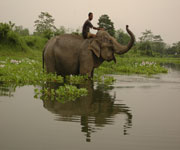
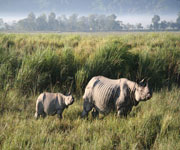
In the heart of Assam, Kaziranga National Park is one of the last areas in eastern India undisturbed by a human presence. It is inhabited by the world's largest population of one-horned rhinoceroses, as well as many mammals, including tigers, elephants, panthers and bears, and thousands of birds. In the heart of Assam, this park is one of the last areas in eastern India undisturbed by a human presence. It is inhabited by the world's largest population of one-horned rhinoceroses, as well as many mammals, including tigers, elephants, panthers and bears, and thousands of birds. Continent: Asia Country: India Category: Natural Criterion: (II)(IV) Date of Inscription: 2011 The Water Coverage of Kaziranga The site is on the southern bank of the Brahmaputra River at the foot of the Mikir Hills. The park lies in the flood plains of the Brahmaputra. The riverine habitat consists primarily of tall, dense grasslands interspersed with open forests, interconnecting...

Humayun's Tomb India

Image
Humayun's Tomb, built in 1570, is of particular cultural significance as it was the first garden-tomb on the Indian subcontinent. It inspired several major architectural innovations, culminating in the construction of the Taj Mahal. Exemplifying the formative stage of the Mughal structural style, Humayun's Tomb stands as a landmark in the development of Mughal architecture, and also represents the earliest extant specimen of the Mughal scheme of the garden tomb, with causeways and channels. It is a well-developed specimen of the double-domed elevation with kiosks on a grand scale. This building tradition culminated in the Taj Mahal, constructed a century later. Despite being the first standardized example of this style, Humayun's Tomb is an architectural achievement of the highest order. Continent: Asia Country: India Category: Cultural Criterion: (II)(IV) Date of Inscription: 2011 The Tomb of Humayun The tomb of Humayun, second Mughal Emperor of India...

The City of Victory

Image
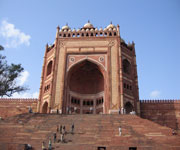
Built during the second half of the 16th century by the Emperor Akbar, Fatehpur Sikri or the City of Victory was the capital of the Mughal Empire for only some 10 years. The complex of monuments and temples, all in a uniform architectural style, includes one of the largest mosques in India, the Jama Masjid. Fatehpur Sikri bears exceptional testimony to the Mughal civilization at the end of the 16th century. It offers a unique example of architectural ensembles of very high quality constructed between 1571 and 1585. Its form and layout strongly influenced the evolution of Indian town planning, notably at Shahjahanabad (Old Delhi). Continent: Asia Country: India Category: Cultural Criterion: (II)(III) (IV) Date of Inscription: 1986 Fatehpur Sikri The 'City of Victory' had only an ephemeral existence as the capital of the Mughal Empire. The Emperor Akbar (1556-1605) decided to construct it in 1571, on the same site where the birth of his son, the future J...

Ellora Caves Monasteries and Temples

Image
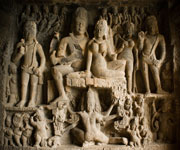
The 34 Ellora Caves Monasteries and Temples, extending over more than 2 km, were dug side by side in the wall of a high basalt cliff, not far from Aurangabad, in Maharashtra. Ellora, with its uninterrupted sequence of monuments dating from A.D. 600 to 1000, brings the civilization of ancient India to life. Not only is the Ellora complex a unique artistic creation and a technological exploit but, with its sanctuaries devoted to Buddhism, Hinduism and Jainism, it illustrates the spirit of tolerance that was characteristic of ancient India. Continent: Asia Country: India Category: Cultural Criterion: (I)(III) (VI) Date of Inscription: 1983

City of Caves

Image
The 'City of Caves', on an island in the Sea of Oman close to Bombay, contains a collection of rock art linked to the cult of Shiva. Here, Indian art has found one of its most perfect expressions, particularly the huge high reliefs in the main cave. The island of Elephanta, the glorious abode of Lord Shiva and an epitome of Hindu cave culture, consists of seven caves on an island in the Sea of Oman close to Mumbai which, with their decorated temples and the images from Hindu mythology, bear a unique testimony to a civilization that has disappeared. Here, Indian art has found one of its most perfect expressions, particularly in the huge high reliefs in the main cave. Continent: Asia Country: India Category: Cultural Criterion: (I)(III) Date of Inscription: 1987

Group of Buddhist Monuments Sanchi

Image
On a hill overlooking the plain and about 40 km from Bhopal, the site of Sanchi comprises a group of Buddhist monuments (monolithic pillars, palaces, temples and monasteries) all in different states of conservation most of which date back to the 2nd and 1st centuries B.C. It is the oldest Buddhist sanctuary in existence and was a major Buddhist centre in India until the 12th century A.D. From the time that the oldest preserved monument on the site (Asoka's column with its projecting capital of lions inspired by Achaemenid art) was erected, Sanchi's role as intermediary for the spread of cultures and their peripheral arts throughout the Maurya Empire, and later in India of the Sunga, Shatavahana, Kushan and Gupta dynasties, was confirmed. Continent: Asia Country: India Category: Cultural Criterion: (I)(II) (III)(IV) (VI) Date of Inscription: 1989

Palace fort of Shahjahanabad

Image
The Red Fort Complex was built as the palace fort of Shahjahanabad – the new capital of the fifth Mughal Emperor of India, Shah Jahan. Named for its massive enclosing walls of red sandstone, it is adjacent to an older fort, the Salimgarh, built by Islam Shah Suri in 1546, with which it forms the Red Fort Complex. The private apartments consist of a row of pavilions connected by a continuous water channel, known as the Nahr-i-Behisht (Stream of Paradise). The Red Fort is considered to represent the zenith of Mughal creativity which, under the Shah Jahan, was brought to a new level of refinement. Continent: Asia Country: India Category: Cultural Criterion: (II)(III) (VI) Date of Inscription: 2007

Astronomical observation Jantar Mantar

Image
The Jantar Mantar, in Jaipur, is an astronomical observation site built in the early 18th century. It includes a set of some 20 main fixed instruments. They are monumental examples in masonry of known instruments but which in many cases have specific characteristics of their own. Designed for the observation of astronomical positions with the naked eye, they embody several architectural and instrumental innovations. This is the most significant, most comprehensive, and the best preserved of India's historic observatories. It is an expression of the astronomical skills and cosmological concepts of the court of a scholarly prince at the end of the Mughal period. Continent: Asia Country: India Category: Cultural Criterion: (III)(IV) Date of Inscription: 2010

Victorian Gothic Revival Chhatrapati Shivaji Terminus

Image
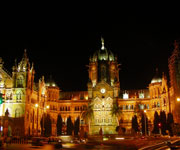
Chhatrapati Shivaji Terminus is an outstanding example of late 19th-century railway architecture in the British Commonwealth, characterized by Victorian Gothic Revival and traditional Indian features, as well as its advanced structural and technical solutions. It became a symbol for Bombay (now Mumbai) as a major mercantile port city on the Indian subcontinent within the British Commonwealth. Continent: Asia Country: India Category: Cultural Criterion: (II)(IV) Date of Inscription: 2004

Ancient Hindu architecture Champaner-Pavagadh Archaeological Park

Image
The Champaner-Pavagadh Archaeological Park with its ancient Hindu architecture, temples and special water-retaining installations, together with its religious, military and agricultural structures, dating back to the regional capital city built by Mehmud Begda in the 16th century, represents a perfect blend of Hindu and Muslim architecture, mainly in the Great Mosque (Jami Masjid), which was a model for later mosque architecture in India. This special style comes from the significant period of regional sultanates. It is furthermore an outstanding example of a very short-lived capital, making the best use of its setting, topography and natural. Continent: Asia Country: India Category: Cultural Criterion: (III)(IV) (V) (VI) Date of Inscription: 2011

World Heritage Ellora Caves India

Image
The Ellora Caves not only bear witness to three great religions Buddhism, Brahminism and Jainism but they also illustrate the spirit of tolerance, characteristic of ancient India, which permitted these three religions to establish their sanctuaries and their communities in a single place, which thus served to reinforce its universal value. The caves, with their uninterrupted sequence of from 600 to 1,000 monuments, bring to life again the civilization of ancient India. Continent: Asia Country: India Category: Cultural Criterion: (I)(III) (VI) Date of Inscription: 1983

Nanda Devi and Valley of Flowers National Parks India

Image
Nestled high in West Himalaya, India's Valley of Flowers National Park is renowned for its meadows of endemic alpine flowers and outstanding natural beauty. This richly diverse area is also home to rare and endangered animals, including the Asiatic black bear, snow leopard, brown bear and blue sheep. The gentle landscape of the Valley of Flowers National Park complements the rugged mountain wilderness of Nanda Devi National Park. Together they encompass a unique transition zone between the mountain ranges of the Zanskar and Great Himalaya, praised by mountaineers and botanists for over a century and in Hindu mythology for much longer. The Nanda Devi National Park is one of the most spectacular wilderness areas in the Himalayas. It is dominated by the peak of Nanda Devi, which rises to over 7,800 m. No people live in the park, which has remained more or less intact because of its inaccessibility. It is the habitat of several endangered mammals, especially the snow leopard, Himalay...

Agra Fort India

Image
Near the gardens of the Taj Mahal stands the important 16th-century Mughal monument known as the Red Fort of Agra. This powerful fortress of red sandstone encompasses, within its 2.5-km-long enclosure walls, the imperial city of the Mughal rulers. It comprises many fairy-tale palaces, such as the Jahangir Palace and the Khas Mahal, built by Shah Jahan; audience halls, such as the Diwan-i-Khas; and two very beautiful mosques. The Red Fort and the Taj Mahal bear an exceptional and complementary testimony to a civilization which has disappeared, that of the Mogul Emperors. Agra's history goes back more than 2,500 years, but it was not until the reign of the Mughals that Agra became more than a provincial city. Continent: Asia Country: India Category: Cultural Criterion: (III) Date of Inscription: 1983

Sundarbans National Park India

Image
The Sundarbans covers 10,000 km2 of land and water (more than half of it in India, the rest in Bangladesh) in the Ganges delta. It contains the world's largest area of mangrove forests. A number of rare or endangered species live in the park, including tigers, aquatic mammals, birds and reptiles. Sundarbans National Park lies south-east of Calcutta in the District of West Bengal and forms part of the Gangetic Delta, which borders on the Bay of Bengal. The Sundarbans, covering some 10,000 km2 of mangrove forest and water, is part of the world's largest delta formed from sediments deposited by three great rivers, the Ganges, Brahmaputra and Meghna, which converge on the Bengal Basin. Continent: Asia Country: India Category: Natural Criterion: (IX)(X) Date of Inscription: 1987