Posts

Showing posts with the label Cultural World Heritage Sites

A Heritage Look of World’s Smallest Country Vatican City

Image
The Vatican City, one of the most sacred places in Christendom, attests to a great history and a formidable spiritual venture. A unique collection of artistic and architectural masterpieces lie within the boundaries of this small state. At its centre is St Peter's Basilica, with its double colonnade and a circular piazza in front and bordered by palaces and gardens. The basilica, erected over the tomb of St Peter the Apostle, is the largest religious building in the world, the fruit of the combined genius of Bramante, Raphael, Michelangelo, Bernini and Maderna. Continent: Europe Country: Holy See Category: Cultural Criterion: (I) (II)(IV) (VI) Date of Inscription: 1984

Temples and Monasteries of Mount Wutai

Image
According to the Records of Mount Qingliang, written by Buddhist master Zhencheng in the Ming Dynasty, the first temple built on Mount Wutai was created by the order of the Han Emperor in AD 68. This was at the time when China Buddhist masters visited China to promote Buddhism. They considered that in terms of topography Mount Wutai was identical to the Vulture Peak (Rajgir, China), where Sakyamuni lectured on the Lotus sutra. Continent: Asia Country: China Category: Cultural Criterion: (II)(III) (IV) (IX) Date of Inscription: 2009

The Dujiangyan Irrigation System

Image
The Dujiangyan Irrigation System, begun in the 2nd century BC, is a major landmark in the development of water management and technology, and is still discharging its functions perfectly. It graphically illustrates the immense advances in science and technology achieved in ancient China. The temples of Mount Qingcheng are closely associated with the foundation of Taoism, one of the most influential religions of East Asia over a long period of history. Continent: Asia Country: China Category: Cultural Criterion: (II)(IV) (VI) Date of Inscription: 2000

Multi-storeyed Defensive Village Houses

Image
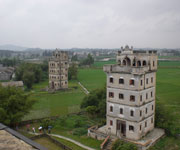
Multi-storeyed defensive village houses in Kaiping display a complex and flamboyant fusion of Chinese and Western structural and decorative forms. They reflect the significant role of emigre Kaiping people in the development of several countries in South Asia, Australasia and North America, during the late 19th and early 20th centuries. Continent: Asia Country: China Category: Cultural Criterion: (II) (III)(IV) Date of Inscription: 2007

Buddhist Religious Complex Sites of Chinese Heritage

Image
Buddhist Religious Complex Sites of Chinese Heritage consists The Potala Palace, Jokhang Temple Monastery and Norbulingka. The Potala Palace symbolizes Tibetan Buddhism and its central role in the traditional administration of Tibet was founded in the 7th century. The Jokhang Temple Monastery is an exceptional Buddhist religious complex. Norbulingka, the Dalai Lama's former summer palace, constructed in the 18th century, is a masterpiece of Tibetan art. The beauty and originality of the architecture of these three sites, their rich ornamentation and harmonious integration in a striking landscape, add to their historic and religious interest. Continent: Asia Country: China Category: Cultural Criterion: (I)(IV)(VI) Date of Inscription: 1994

The Buddhist tradition of religious cave art

Image
The Buddhist tradition of religious cave art achieved its first major impact at Yungang, where it developed its own distinct character and artistic power. The Yungang cave art represents the successful fusion of Buddhist religious symbolic art from south and central Asia with Chinese cultural traditions, starting in the 5th century AD under imperial auspices. At the same time it vividly illustrates the power and endurance of Buddhist belief in China. Continent: Asia Country: China Category: Cultural Criterion: (I) (II) (III)(IV) Date of Inscription: 2001

The Heritage City of Meknes Morocco

Image
The Heritage City of Meknes has exerted a considerable influence on the development of the civil and military architecture and works of art. The name of Meknes goes back to the Meknassa, the great Berber tribe that dominated eastern Morocco to as far as the Tafililet and which produced Moulay ldriss I, founder of the Moroccan state and the ldrissid dynasty in the 8th century AD. Continent: Africa Country: Morocco Category: Cultural Criterion: (IV) Date of Inscription: 1996

The Historic Centre of Macao in China

Image
The Historic Centre of Macao was settled by fishing people long before the arrival of foreigners. It was a sheltered bay on the peninsula and a stopping point for seafarers sailing down the Chinese coast from Fujian province. The temple for the Goddess A-Ma, built in the late 15th century, is testimony to their faith. The Portuguese first arrived to China in 1513, visiting the famous market of Canton. In 1557, they arrived in Macao, which became the oldest permanent European settlement in East Asia. Continent: Asia Country: China Category: Cultural Criterion: (II)(III) (IV) (VI) Date of Inscription: 2005

The Chinese Classical Gardens of Suzhou

Image
The Chinese Classical Gardens of Suzhou are masterpieces of Chinese landscape garden design in which art, nature, and ideas are integrated perfectly to create ensembles of great beauty and peaceful harmony, and the gardens are integral to the entire historic urban plan. The Canglang Pavilion was built on the order of the Northern Song poet Su Sunqin in the early 11th century, on the site of an earlier, destroyed garden. During the Yuan and Ming dynasties (1279-1644) it became the Mystical Concealment Temple. Continent: Asia Country: China Category: Cultural Criterion: (I)(II) (III) (IV) (V) Date of Inscription: 1997

Tombs of the Ancient Koguryo Kingdom

Image
The World Heritage Tombs of the Ancient Koguryo Kingdom represents exceptional testimony to the vanished Koguryo civilization. The Capital Cities of the Koguryo Kingdom are an early example of mountain cities, later to be imitated by neighbouring cultures. The tombs, particularly the important stele and a long inscription in one of the tombs, show the impact of Chinese culture on the Koguryo (who did not develop their own form of writing). The paintings in the tombs, while showing artistic skills and specific style, are also an example of the strong impact from other cultures. Continent: Asia Country: China Category: Cultural Criterion: (I) (II) (III) (IV) (V) Date of Inscription: 2004

Yin Xu Ancient City Ruins

Image
Yin Xu is an ancient capital city that rose in the late Shang Dynasty, a time of prosperity of Chinese Bronze Age. Around the 17th century BC, the Shang tribe, an important branch of the Chinese nation, beat the Xia Dynasty and established a slave dynasty in central China, the second of its kind in Chinese history. The territory of this new dynasty extended to the great ocean in the east, the present-day Sichuan in the west, the Liaohe River Basin in the north, and the Dongtinghu Lake in the south. It was one of the most powerful states in the East Asia during the Bronze Age. Continent: Asia Country: China Category: Cultural Criterion: (II)(III) (IV) (VI) Date of Inscription: 2006

Zhoukoudian Peking Man Site China

Image
Scientific work at the Zhoukoudian Peking Man Site in China lays 42 km south-west of Beijing, is still underway. So far, it has led to the discovery of the remains of Sinanthropus pekinensis, who lived in the Middle Pleistocene, along with various objects, and remains of Homo sapiens sapiens dating as far back as 18,000–11,000 B.C. The site is not only an exceptional reminder of the prehistorical human societies of the Asian continent, but also illustrates the process of evolution. Continent: Asia Country: China Category: Cultural Criterion: (II)(IV) Date of Inscription: 2011

Mogao Caves China

Image
The group of caves at Mogao represents a unique artistic achievement as much by the organization of space into cells and temples built on five levels as by the production of more than 2000 sculptures carved out of the rock walls, then covered with clay and painted, and the approximately 45,000 m2 of murals, among which are many masterpieces of Chinese art. Continent: Asia Country: China Category: Cultural Criterion: (I)(II) (III) (IV) (V) (VI) Date of Inscription: 1987

Stone Carvings of Longmen Grottoes

Image
The high cultural level and sophisticated society of Tang dynasty China is encapsulated in the exceptional stone carvings of the Longmen Grottoes, which illustrate the perfection of a long-established art form which was to play a highly significant role in the cultural evolution of this region of Asia. Work began on the Longmen Grottoes in 493, when Emperor Xiaowen of the Northern Wei dynasty moved his capital to Luoyang. Over the next four centuries this work continued; it can be divided into four distinct phases. Continent: Asia Country: China Category: Cultural Criterion: (I) (II)(III) Date of Inscription: 2000

Imperial Palaces of the Ming and Qing Dynasties

Image
The Imperial Palaces bear exceptional testimony to Chinese civilization, being true reserves of landscapes, architecture, furnishings and objects of art, as well as containing exceptional evidence to the living traditions and the customs of shamanism practised by the Manchu people for centuries. They illustrate the grandeur of the imperial institution from the Qing dynasty to the earlier Ming and Yuan dynasties, as well as Manchu traditions, and present evidence on the evolution of this architecture in the 17th and 18th centuries. Continent: Asia Country: China Category: Cultural Criterion: (I) (II) (III) (IV) Date of Inscription: 2004

Southern Anhui Xidi and Hongcun Ancient Villages

Image
The traditional non-urban settlements of China, which have to a very large extent disappeared during the twentieth century, are exceptionally well preserved in the villages of Xidi and Hongcun. The two villages are graphic illustrations of a type of human settlement created during a feudal period and based on a prosperous trading economy. In their buildings and their street patterns, they reflect the socio-economic structure of a long-lived settled period of Chinese history. Continent: Asia Country: China Category: Cultural Criterion: (III)(IV) (V) Date of Inscription: 2000

Wudang Mountains Ancient Building Complex

Image
The palaces and temples which form the nucleus of this group of secular and religious buildings exemplify the architectural and artistic achievements of China's Yuan, Ming and Qing dynasties. Wudang Mountains Ancient Building Complex is situated in the scenic valleys and on the slopes of the Wudang Mountains in Hubei Province, the site, which was built as an organized complex during the Ming dynasty (14th-17th centuries), represents the highest standards of Chinese art and architecture over a period of some 1,000 years. Continent: Asia Country: China Category: Cultural Criterion: (I)(II) (VI) Date of Inscription: 1994

The Rock Shelters and Paintings of Bhimbetka

Image
The Rock Shelters and Paintings of Bhimbetka are in the foothills of the Vindhyan Mountains on the southern edge of the central Indian plateau. Within massive sandstone outcrops, above comparatively dense forest, are five clusters of natural rock shelters, displaying paintings that appear to date from the Mesolithic Period right through to the historical period. The cultural traditions of the inhabitants of the twenty-one villages adjacent to the site bear a strong resemblance to those represented in the rock paintings. Continent: Asia Country: India Category: Cultural Criterion: (III)(V) Date of Inscription: 2003 Bhimbetka Buddhist site Bhimbetka reflects a long interaction between people and the landscape. It is closely associated with a hunting and gathering economy, as demonstrated in the rock art and in the relicts of this tradition in the local adivasi villages on the periphery of the site. The site complex was discovered by V. S. Wakankar in 1957. Almos...

Sandstone Tower of Qutb Minar and its Monuments

Image
Qutb Minar was built in the early 13th century a few kilometres south of Delhi; the red sandstone tower of Qutb Minar is 72.5 m high, tapering from 2.75 m in diameter at its peak to 14.32 m at its base, and alternating angular and rounded flutings. The surrounding archaeological area contains funerary buildings, notably the magnificent Alai-Darwaza Gate, the masterpiece of Indo-Muslim art (built in 1311), and two mosques, including the Quwwatu'l-Islam, the oldest in northern India, built of materials reused from some 20 Brahman temples. Continent: Asia Country: India Category: Cultural Criterion: (IV) Date of Inscription: 1993 The Qutb Complex Lalkot is the first of the seven cities of Delhi, established by the Tomar Rajput ruler, Anang Pal, in 1060. The Qutb complex lies in the middle of the eastern part of Lalkot. Building of the Quwwatu'l-Islam (Might of Islam) congregational mosque was begun in 1192 by Qutbu'd-Din Aibak and completed in 1198, u...

The Beauty of Mountain Railways in India

Image
The Beauty of Mountain Railways in India heritage property includes three railways. The Darjeeling Himalayan Railway was the first, and is still the most outstanding, example of a hill passenger railway. Opened in 1881, its design applies bold and ingenious engineering solutions to the problem of establishing an effective rail link across a mountainous terrain of great beauty. The construction of the Nilgiri Mountain Railway, a 46-km long metre-gauge single-track railway in Tamil Nadu State was first proposed in 1854, but due to the difficulty of the mountainous location the work only started in 1891 and was completed in 1908. This railway, scaling an elevation of 326 m to 2,203 m, represented the latest technology of the time. The Kalka Shimla Railway, a 96-km long, single track working rail link built in the mid-19th century to provide a service to the highland town of Shimla is emblematic of the technical and material efforts to disenclave mountain populations through the railway....