Posts

Showing posts with the label Heritage National Parks

Manas Wildlife Sanctuary Assam
Image
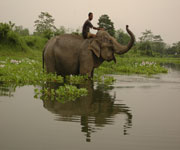
Manas takes its name from the Goddess Manasa. The Manas Wildlife Sanctuary is noted for its spectacular scenery, with a variety of habitat types that support a diverse fauna, making it the richest of all Indian wildlife areas. The park represents the core of an extensive tiger reserve that protects an important migratory wildlife resource along the West Bengal to Arunachal Pradesh and Bhutan borders. Its wetlands are of international importance. It is also the single most important site for the survival of pygmy hog, hispid hare and golden langur. Continent: Asia Country: India Category: Natural Criterion: (VII)(IX) (X) Date of Inscription: 1985 Manas Reserve Forest The park, which includes part of Manas Reserve Forest and all of North Kamrup Reserve Forest, constitutes the core of Manas Tiger Reserve located in the forest divisions of Kachugaon, Haltugaon, Western Assam Wildlife and North Kamrup. Lying in the foothills of the Outer Himalaya, the area is low-l...

Keoladeo National Park Rajasthan

Image
Keoladeo National Park is situated in eastern Rajasthan, the park is 2 km south-east of Bharatpur and 50 km west of Agra. The area consists of a flat patchwork of marshes in the Gangetic plain, artificially created in the 1850s and maintained ever since by a system of canals, sluices and dykes. Normally, water is fed into the marshes twice a year from inundations of the Gambira and Banganga rivers, which are impounded on arable land by means of an artificial dam called Ajan Bund, to the south of the park. The first time, usually in mid-July, is soon after the onset of the monsoon and the second time is in late September or October when Ajan Bund is drained ready for cultivation in winter. Continent: Asia Country: India Category: Natural Criterion: (X) Date of Inscription: 1985 Keoladeo Monsoon Thus, the area is flooded to a depth of 1-2 m throughout the monsoon (July-September), after which the water level drops. From February onwards the land begins to dry ou...

Kaziranga National Park India

Image
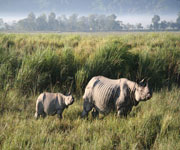
In the heart of Assam, Kaziranga National Park is one of the last areas in eastern India undisturbed by a human presence. It is inhabited by the world's largest population of one-horned rhinoceroses, as well as many mammals, including tigers, elephants, panthers and bears, and thousands of birds. In the heart of Assam, this park is one of the last areas in eastern India undisturbed by a human presence. It is inhabited by the world's largest population of one-horned rhinoceroses, as well as many mammals, including tigers, elephants, panthers and bears, and thousands of birds. Continent: Asia Country: India Category: Natural Criterion: (II)(IV) Date of Inscription: 2011 The Water Coverage of Kaziranga The site is on the southern bank of the Brahmaputra River at the foot of the Mikir Hills. The park lies in the flood plains of the Brahmaputra. The riverine habitat consists primarily of tall, dense grasslands interspersed with open forests, interconnecting...

Lushan National Park China

Image
The World Heritage site consists of a cultural landscape of outstanding aesthetic value and with powerful associations with Chinese spiritual and cultural life. Lushan (Mount Lu) is an area of striking scenic beauty and interest from the point of view of the natural environment that has attracted spiritual leaders and scholars, and also artists and writers, for over two millennia. The mountains have been the inspiration for some of the finest Chinese classical poetry. It is a landscape that has inspired philosophy and art, and into which high-quality cultural properties have been selectively and sensitively integrated up to the present century. Continent: Asia Country: China Category: Cultural Criterion: (II) (III) (IV) (VI) Date of Inscription: 1996

Hortobagy National Park the Puszta Hungary

Image
The landscape of the Hungarian Pasta, an outstanding example of a cultural landscape shaped by a pastoral human society, preserves intact and visible the evidence of its traditional use over more than two millennia and represents the harmonious interaction between human beings and nature. The Puszta consists of a vast area of plains and wetlands in eastern Hungary. Traditional forms of land use, such as the grazing of domestic animals, have been present in this pastoral society for more than two millennia. Continent: Europe Country: Hungary Category: Cultural Criterion: (IV)(V) Date of Inscription: 1999

Pirin National Park Bulgaria

Image
Pirin National Park is extending over an area of 27,400 ha and lying at an altitude of 1,008-2,914 m in the Pirin Mountains, south-west Bulgaria, Pirin National Park has a limestone Balkan landscape, with lakes, waterfalls, caves and pine forests. The rugged mountains, with some 70 glacial lakes scattered throughout them, are home to hundreds of endemic and rare species, many of which are representative of the Balkan Pleistocene flora. The mountains also have diverse and unique landscapes of great aesthetic value. Continent: Europe Country: Bulgaria Category: Natural Criterion: (VII)(VIII) (IX) Date of Inscription: 1983

Tongariro National Park New Zealand

Image
The Maoriare is a Polynesian people who reached Aotearoa (New Zealand) before AD 1300 (and possibly as early as AD 600-800). They came as settlers in large double-hulled canoes -men, women, and children, with their plants and domestic animals. One of the most important was the Arawa canoe, which made its first landfall at Whangaparaoa on North Island's East Cape and then travelled to Maketu in the Bay of Plenty. The descendants of that canoe still hold authority over the land as far south as the Tongariro National Park. The people of the Park - Ngati Tuwharetoa - identify with Ngatoroirangi, the navigator of the Arawa canoe and legendary bringer of fire to Tongariro. Continent: Oceania Country: New Zealand Category: Mixed Heritage Criterion: (VI)(VI) (VIII) Date of Inscription: 1993

World Heritage W National Park of Niger

Image
The part of 'W' National Park that lies in Niger is situated in a transition zone between savannah and forest lands and represents important ecosystem characteristics of the West African Woodlands/Savannah Biogeographical Province. The site reflects the interaction between natural resources and humans since Neolithic times and illustrates the evolution of biodiversity in this zone. The 'W' National Park, so named because of the local configuration of the Niger River (220,000 ha), is located in a transition zone between Sudan and Guinea savannahs and contiguous to 'W' National Parks in both Burkina Faso and Benin, and the Reserve de Faune de Tamou to the north. Shrub savannah is the most widespread vegetation type occurring on shallow infertile soils. Continent: Africa Country: India Category: Natural Criterion: (IX)(X) Date of Inscription: 1996

Mammoth Cave National Park USA

Image
Mammoth Cave National Park, located in the state of Kentucky, has the world's largest network of natural caves and underground passageways, which are characteristic examples of limestone formations. The park includes by far the longest cave system in the world, with known passages extending some 550 km. It is of geological importance due to the 25 million years of cave-forming action by the Green River and its tributaries. Almost every type of cave formation is known within the site and the geological processes involved in cave formation are continuing. The long passages with huge chambers, vertical shafts, stalagmites and stalactites, gypsum 'flowers' and 'needles' and other natural features of the cave system are all superlative examples of their types. The park and its underground network of more than 550 km surveyed passageways are home to varied flora and fauna (including a number of endangered species). Continent: North America Country: United States...

The World Heritage Great Smoky Mountains National Park

Image
The World Heritage Great Smoky Mountains National Park is the most important natural area in the eastern United States and is of world importance as an example of temperate deciduous hardwood forest and thus an outstanding example of the diverse Arcto-Tertiary geoflora era, having a high number of temperate species with some rich mixed stands. During Pleistocene glaciation it was the major North American refuge for temperate and boreal species of flora and fauna, so has a large number of endemic species as well as an extremely rich species composition. With 130 species of tree, it has almost as many species as all of Europe. This has resulted in a rich vegetation mosaic. It harbours many endangered species of animals, and has possibly the greatest diversity of salamanders in the world; it is a centre of endemism for North American molluscs. Continent: North America Country: United States of America Category: Cultural Criterion: (VII)(VIII) (IX) (X) Date of Inscription: ...

Limestone Caves Carlsbad Caverns National Park

Image
The more than 100 limestone caves within Carlsbad Caverns National Park are outstanding and notable world-wide because of their size, mode of origin, and the abundance, diversity and beauty of the speleothems (decorative rock formations) within. On-going geologic processes continue to form rare and unique speleothems, particularly in Lechuguilla Cave. Carlsbad Caverns and Lechuguilla Cave are well known for their great natural beauty, exceptional geologic features, and unique reef and rock formations. The Permian-aged Capitan Reef complex (in which Carlsbad Caverns, Lechuguilla and other caves formed) is one of the best preserved and most accessible complexes available for scientific study in the world. Continent: North America Country: United States of America Category: Natural Criterion: (VII)(VIII) Date of Inscription: 1995

Volcanoes National Park Hawaii

Image
Volcanoes National Park Hawaii, contains two of the most active volcanoes in the world, Mauna Loa and Kilauea both of which tower over the Pacific Ocean. Volcanic eruptions have created a constantly changing landscape, and the lava flows reveal surprising geological formations. Rare birds and endemic species can be found there, as well as forests of giant ferns. Hawaii Volcanoes National Park contains Mauna Loa and Kilauea, two of the world's most active and accessible volcanoes where on-going geological processes are easily observed. This property serves as an excellent example of island building through volcanic processes. Through the process of shield-building volcanism, the park's landscape is one of relatively constant, dynamic change. Continent: North America Country: United States of America Category: Natural Criterion: (VIII) Date of Inscription: 1987

The World Heritage Yosemite National Park

Image
The World Heritage Yosemite National Park, on the west slope of the central Sierra Nevada Mountains, is an area of outstanding scenic beauty and great wilderness value. The park represents practically all the different environments found within the Sierra Nevada, including sequoia groves, historic resources, evidence of Indian habitation, and domes, valleys, polished granites and other geological features illustrating the formation of the mountain range. Continent: North America Country: United States of America Category: Natural Criterion: (VII)(VIII) Date of Inscription: 1984

The Nature beauty Grand Canyon National Park

Image
The Nature beauty Grand Canyon National Park was created on 26 February 1919 by an act of Congress. First protected in 1893 as a forest reserve in which mining, lumbering and hunting continued to be allowed: upgraded to a game reserve in 1906, giving protection to the wildlife: redesignated a National Monument in 1908.The park is dominated by the spectacular Grand Canyon: a twisting, 1.5 km deep and 445.8 km long gorge, formed during some 6 million years of geological activity and erosion by the Colorado River on the raised Earth's crust (2.5 km above sea level). It divides the park into the North Rim and South Rim which overlook the 200 m to 30 km wide canyon; the buttes, spires, mesas and temples in the canyon are in fact mountains looked down upon from the rims. Continent: North America Country: United States of America Category: Natural Criterion: (VII)(VIII) (IX) (X) Date of Inscription: 1979

World Heritage Yellowstone National Park

Image
World Heritage Yellowstone National Park, established in 1872, covers 9,000 km2 of a vast natural forest of the southern Rocky Mountains in the North American west. It boasts an impressive array of geothermal phenomena, with more than 3,000 geysers, lava formations, fumaroles, hot springs and waterfalls, lakes and canyons. It is equally known for its wildlife: grizzly bears, bison, wolves and wapiti, North American elk. The park is part of the most seismically active region of the Rocky Mountains, a volcanic 'hot spot'. The Yellowstone Plateau, now a forested area of 650,000 ha with an average elevation of 2,000 m, was formed out of the accumulation of rhyolite magma. Continent: North America Country: United States of America Category: Natural Criterion: (VII)(VIII) (IX) (X) Date of Inscription: 1978

Mesa Verde National Park Heritage

Image
Mesa Verde National Park is among the American Indian civilizations recognized by ethnologists and prehistorians, that of the Anasazi Indians and of their distant descendants, the Pueblos of New Mexico and Arizona are indeed quite original, owing in part to the substantial rigours of their natural environment: the south-western part of Colorado with its mesas cut by deep canyons. On the high limestone and sandstone plateau, which in one place reaches an altitude of 2,620 m above sea level, the climate is semi-arid, being characterized by irregular precipitation and great differences between day and night temperature. The first signs of regular human occupation go back to the 6th century of the current era. They are principally located on the plateau where partially buried villages, consisting of silos and low dwellings, have existed since this period. Original handicrafts, in which the production of yucca fibre objects play a major role, was to remain characteristic of Anasazi civili...

Redwood National Park Heritage

Image
Redwood National Park comprises a region of coastal mountains bordering the Pacific (to 930 m above sea level) north of San Francisco. It is covered with a magnificent forest of sequoia redwood trees, the tallest and most impressive trees in the world. The marine and land life are equally remarkable, in particular the sea lions, the bald eagle and the endangered California brown pelican. The park was established specifically to protect these trees, because it is only here and in Oregon that they now survive. Descendants of the giant evergreens that grew during the age of the dinosaurs, redwoods thrived in moist temperate regions of the world. They take 400 years to mature and some of the survivors are more than 2,000 years old. Their thick, sapless bark protects them from fire, but landslides and wind can topple old trees. Cultural landscapes reflect American Indian history. Continent: North America Country: United States of America Category: Natural Criterion: (VII)(IX) ...

Phong Nha-Ke Bang National Park Vietnam

Image
The karst formation of Phong Nha-Ke Bang National Park has evolved since the Palaeozoic (some 400 million years ago) and so is the oldest major karst area in Asia. Subject to massive tectonic changes, the park's karst landscape is extremely complex with many geomorphic features of considerable significance. The vast area, extending to the border of the Lao People's Democratic Republic, contains spectacular formations including 65 km of caves and underground rivers. Phong Nha - Ke Bang National Park is located in the middle of the Annamite Mountain Range in Quang Binh province, Vietnam and shares its boundary with the Hin Namno Nature Reserve in the Lao PDR to the west. The property comprises an area of 85,754 ha and contains terrestrial and aquatic habitats, primary and secondary forest, sites of natural regeneration, tropical dense forests and savanna and is rich in large, often spectacular and scientifically significant caves. Continent: Asia Country: Vietnam Cate...

World Heritage Canaima National Park

Image
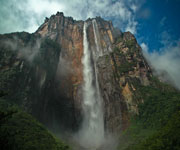
Canaima National Park is spread over 3 million ha in south-eastern Venezuela along the border between Guyana and Brazil. Roughly 65% of the park is covered by table mountain (tepui) formations. The tepuis constitute a unique biogeological entity and are of great geological interest. The sheer cliffs and waterfalls, including the world's highest (1,000 m), form a spectacular landscape. Canaima was established as a national park in 1962 and its size was doubled to the present area in 1975 and inscribed Word Heritage in 1994. Continent: South America Country: Venezuela Category: Natural Criterion: (VII)(VIII) (IX) (X) Date of Inscription: 1994

Wood Buffalo National Park Canada

Image
Wood Buffalo National Park is situated on the plains in the north-central region of Canada; the park is home to North America's largest population of wild bison. It is also the natural nesting place of the whooping crane. Another of the park's attractions is the world's largest inland delta, located at the mouth of the Peace and Athabasca rivers. Wood Buffalo National Park is an outstanding example of ongoing ecological and biological processes, encompassing some of the largest undisturbed grass and sedge meadows left in North America, and it sustains the world's largest herd of wood bison, a threatened species. The park's huge tracts of boreal forest also provide crucial habitat for a diverse range of other species, including the threatened whooping crane. The continued evolution of a large inland delta, salt plains and gypsum karst add to the park's outstanding values. Continent: North America Country: Canada Category: Natural Criterion: (VII)(IX...